
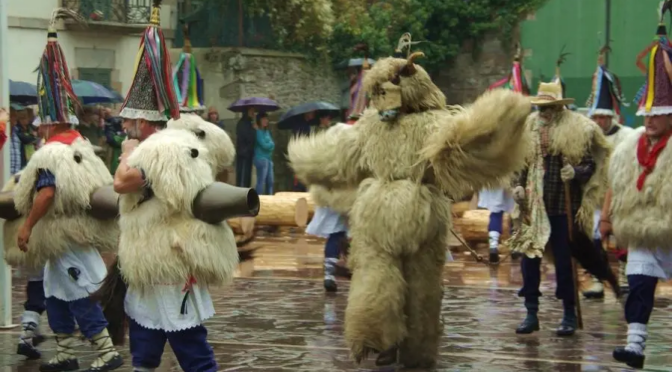
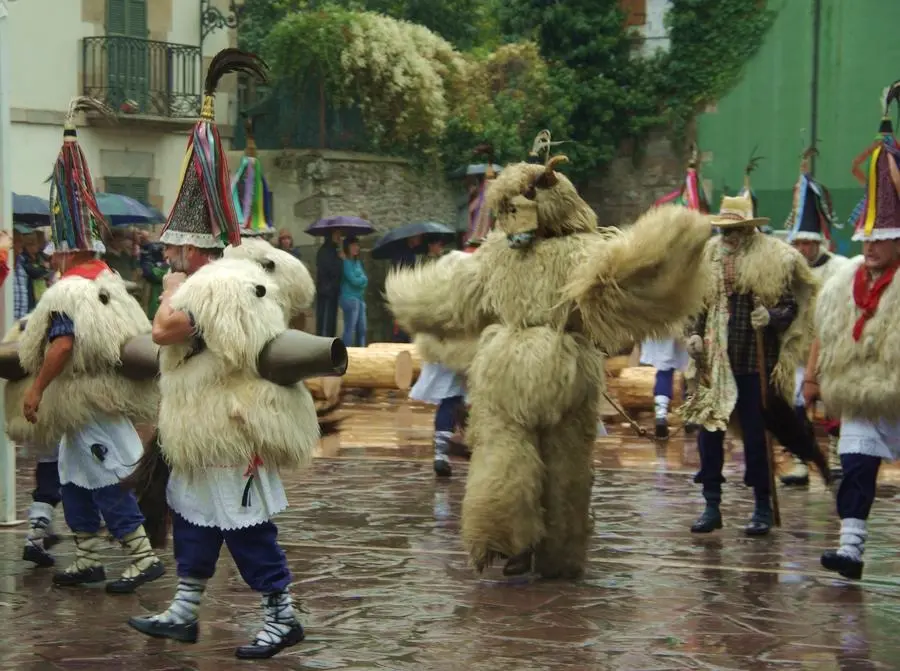
The Basque Country has a long association with bears. Indeed, research by people like Roslyn Frank indicates that the Basques may have worshipped bears at one time and that Basques believed that humans were descended from bears. The importance of bears to Basque culture is reflected in their role in carnivals in various towns. However, despite this importance, real bears have all but disappeared from the Basque landscape, with the last bear sited more than 15 years ago.
- At one time, at least three different species of bears lived in the Pyrenees and the Basque Country, the oldest remains dating over 240,000 years ago. The last native Basque bear, named Camille, had lived in the Roncal Valley but died some time around 2010.
- Hartza, the bear, is the protagonist of more than than one festival in the Basque Country. For example, in Ituren, Nafarroa, the arrival of Hartza and his handler, hartzazain, during their fiesta announces that spring has come.
- There are tales highlighting the relationship between bears and humans, with some telling how Basques are descended from bears. Indeed, in 1983, Petiri Prébende, the last Basque bear hunter, said, “Lehenagoko eüskaldünek gizona hartzetik jiten zela sinhesten zizien. […] Hartzak eginak gara” (“Basques used to believe that humans descended from bears. […] We were created by the bear.”) Bears were said, once shorn, to look like humans and that humans were bears without fur.
- The close relationship meant that bears and humans could interchange souls: “The primitive belief in the possibility of such an exchange of souls comes clearly out in a story of a Basque hunter who affirmed that he had been killed by a bear, but that the bear had, after killing him, breathed its own soul into him, so that the bear’s body was now dead, but he himself was a bear, being animated by the bear’s soul.” (The Golden Bough by JG Frazer)
- One story describes Joan Hartza or Bear’s Son or Little Bear or Hamalau or Hartz-ume (there are many names for this story). This hero was half human, half bear, with a human mother and bear father. He represents the transition from bears to humans and bear ancestry. The story relates his adventures, including his encounter with a group of animals that he helps and is rewarded with talismans of their power. Roslyn Frank suggests that this story, though appearing throughout Europe, originated in the Basque Country.
- There is also some evidence of belief in a Celestial Bear, a bear that helps guard the gates of heaven with St Peter. An English folklorist, Thomas Hollingsworth, was interviewing two Basques from Nafarroa who told him in 1891 that bears could understand human speech, including Euskara, and that bears were smart enough to learn from people and take that knowledge back to other bears, and that this would allow bears to come back and rule over humans as they had once done. They referred to the bear as the “dog of God” and the “dog of St Peter.”
- Though bears have now essentially disappeared from the Basque Country, the last bear hunter was still alive in 1983. He and his son discussed how killing a bear would bring bad luck. However, a bear’s paw has also been seen as a powerful magical item, protecting people from the evil eye and other illnesses.
- One final curious note is worth expanding on. One of the names for the Little Bear is Hamalau, which literally means 14. Frank alludes to the special role that 7 has in Basque culture, and maybe the name 14 is related to this. Hamalau is also a name for the boogeyman, who scares people at night. It is also a large number, representing infinity. Maybe a future post will go into 14 in more detail.
A full list of all of Buber’s Basque Facts of the Week can be found in the Archive.
Primary sources: Hartz, Wikipedia; European Folklore in the longue durée: Palaeolithic Continuity and the European ursine genealogy by Roslyn Frank and Fabio Silva; Frank, R. M. (2023). “The Bear’s Son Tale”: Traces of an ursine genealogy and bear ceremonialism in a pan-European oral tradition. In Bear and Human: Facets of a Multi-Layered Relationship from Past to Recent Times, with Emphasis on Northern Europe (pp. 1107-1120); Frank, Roslyn M, Recovering European Ritual Bear Hunts: A Comparative Study of Basque and Sardinian Ursine Carnival Performances. Insula-3 (June 2008), pp. 41-97. Cagliari, Sardinia. http://www.sre.urv.es/irmu/alguer/